
Views: 231
Victoria BC 2026 Commemoration event of the first use of nuclear weapons in war – the bombing of Hiroshima, 6 August
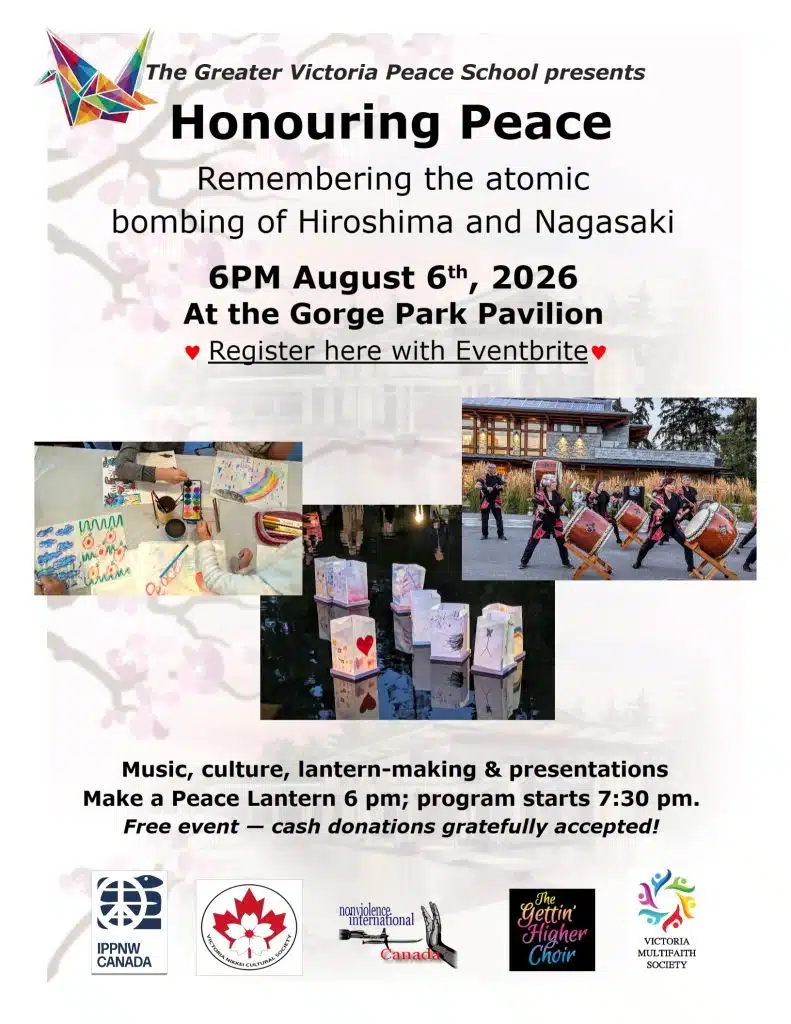
Event is free to attend, we request people register HERE
Commemoration events will occur worldwide, and in Hiroshima.
Victoria, British Columbia was declared a Nuclear Weapons Free City and British Columbia has been a self-declared nuclear-weapons-free zone since 1992.
In June 2019, Victoria endorsed the Cities Appeal of the International Campaign for the Abolition of Nuclear Weapons, along with many other Canadian cities, for the Canadian government to join the Treaty on the Prohibition of Nuclear Weapons.
Hiroshima commemorations hold global and historical significance by serving as a symbol of the desire for peace. Hiroshima commemorations are a vital educational tool to convey the horror and absolute unacceptability of nuclear warfare. Hiroshima commemorations are an urgent rallying call for worldwide nuclear disarmament, and are a solemn public memorial to honor the civilian victims.
While Canada possesses no nuclear weapons, the threat is not distant to us. The largest known stockpile of nuclear weapons resides less than 60 miles from our city, at the US governments Strategic Weapons Facility Pacific in Kitsap-Bangor, Washington State . Once every 10 days, a submarine from that Trident Nuclear Submarine base at Kitsap sails within 10km of Victoria and Sooke as they leave on their regular passage out the Juan de Fuca strait to the Pacific ocean.
Please join us.
Nonviolence International Canada is a co-host of this event.
Also note the following events of remembrance:
Ken Mizokoshi’s photo project remains Nagasaki, involved taking photos of personal belongings such as clock, school uniform and cap that were found around the epicenter of the atomic bomb in Nagasaki. These belongings were discovered on the ground after the bombing. They are part of the collection of the Nagasaki Atomic Bomb Museum, the Urakami Catholic church in Nagasaki, and the medical department of Nagasaki University. He wants people in the world to know about the atomic bomb survivors and the dangers of nuclear weapons. He believes that these personal belongings can deeply convey the tragedy that their owners experienced. He also wants viewers to feel the dreadfulness more personally, at a closer distance, rather than just simply reading statistics about the people who were killed by the bomb. His goal was to encourage viewers to imagine each person’s life through their possessions. This project’s photo exhibition has been held in Nagasaki, Tokyo, New York, and other locations, attracting widespread interest.
Venue and Dates:
Venue1: Greater Victoria Public Library James Bay Branch (385 Menzies Street, Victoria,
BC V8V 0C2) From August 24 th to November 23 rd
Venue 2: The Dock (722 Cormorant Street, Victoria, BC, V8W 1P8) From September 7th to November 23rd
Supported by
Human Rights Committee of Victoria Nikkei Cultural Society
Victoria Arts Council
Across the border in Washington State, activists will gather on the Nagasaki Day weekend to seek an end to nuclear weapons. For further info see: